
“Would You Trust Ross Williams?" - Michael O'Sullivan of Hubpeople and the ODDA Keeps Asking. Here's My Answer, With the Paperwork.
I've stayed quiet for nearly two years. This is the whole story, once, with dates and documents. Then I'm done with it.

Let me start with the part that's all on me, because it's the worst part and I can't escape it - in 2024 I caused the destruction of a company I'd spent 22 years of my life (and the lives of many others) building.
Venntro Media Group. Three of us started it in 2003, and at its peak it turned over $50m and employed close to 200 people. I was proud of it. And I ended up running it into the ground.
On 2 August 2024 it went into administration. Partners who were owed money didn't get paid. Staff lost their jobs. Suppliers were left short. I'd put my own savings in trying to save it - I was the largest personal creditor when it failed - that's not a defence, just a fact - everyone lost. People trusted me and got hurt and lost out on money and careers because of decisions I made.
I'm truly sorry for this and still frustrated that I’ve not been able to do right by staff and partners. The original plan would have enabled us to repay partners and make sure staff were taken care of – but I failed. That failure is mine and I'll carry it.
And for nearly two years now, Michael O'Sullivan - the owner of HubPeople and board member of The Online Dating and Discovery Association (the global industry association for online dating businesses) - has been telling a second story. At industry conferences. To former partners. And lately on LinkedIn, where he asked his network, straight out: "would you trust Ross Williams?"
Since he keeps repeating it, I'm going to answer it once, properly, with the paperwork to prove it.
This didn’t need to happen – I’ve moved on, working outside the dating industry since mid-2025 – but Michael insists on bringing my name up again and again in public settings – it’s only right that I now respond and explain that Michael’s public comments are false and always have been – let me be clear:
1. HubPeople doesn't own Venntro’s database and never did - they have been using it without permission from the data controller despite multiple requests for them to stop.
2. HubPeople didn't lose money to Ambervine – in fact based on our first month operating with Hubpeople, we believe they have generated at least ~£2m gross revenues from members who upgraded on our sites and far more indirectly from the 14.5million members in Venntro’s database that they kept processing without permission.
The people who really lost out are former partners and staff of Venntro – who didn’t get what I hoped they would when we did this deal.
If Michael hadn’t terminated us, we would have been able to make good with those that mattered. Dean, Cliffy, Neil, Steve – they were owed a huge amount of money.
My former business partner Steve also lost all value in his shares and I couldn’t do anything about it – I should have been able to make good with him and others within 6-12 months of moving to Hubpeople – but Michael put a stop to that. I’m sure you’re skeptical – especially if you’ve heard or read these comments – if so read on - this is his post that prompted me to finally go public and share my side of the story, as Michael seems intent on continuing to use my name on Linkedin and spread these lies.
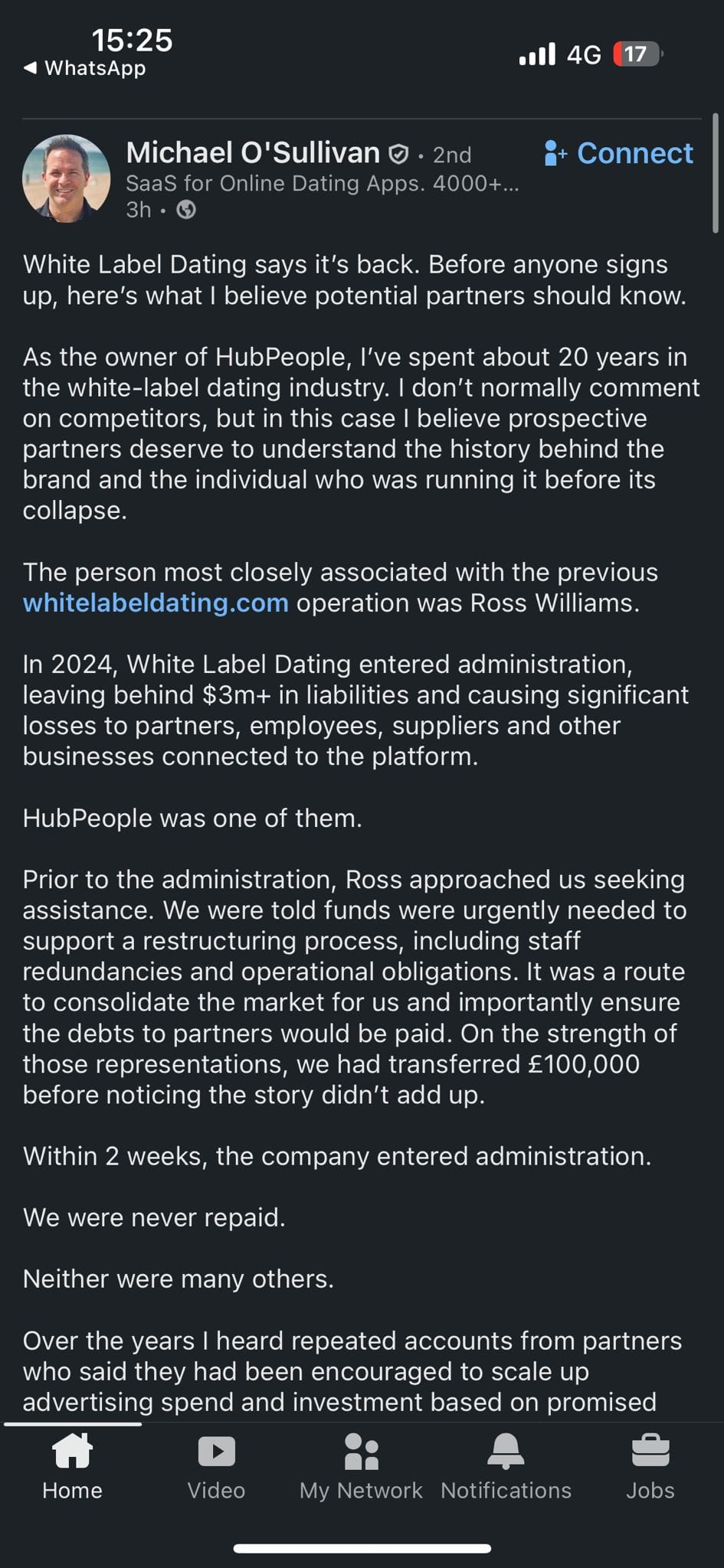
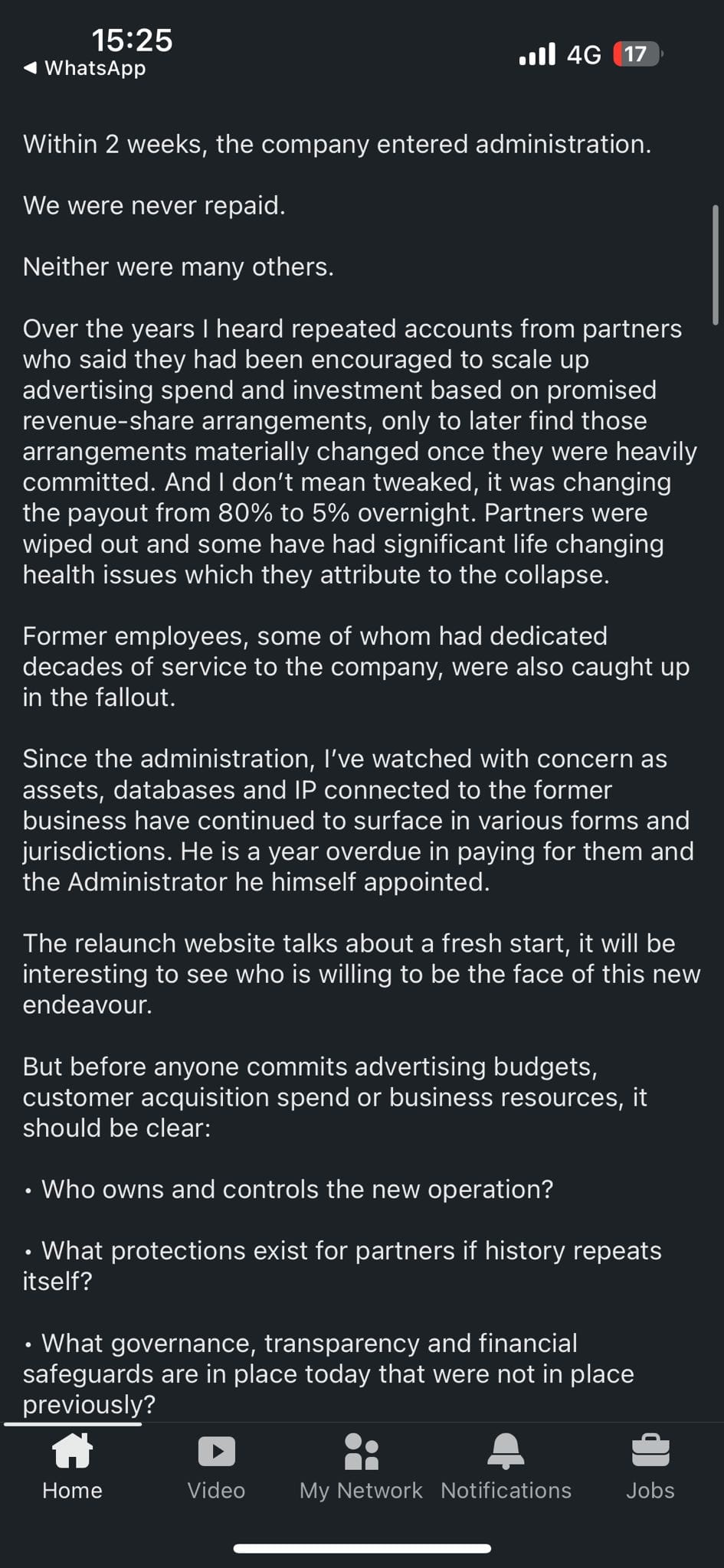
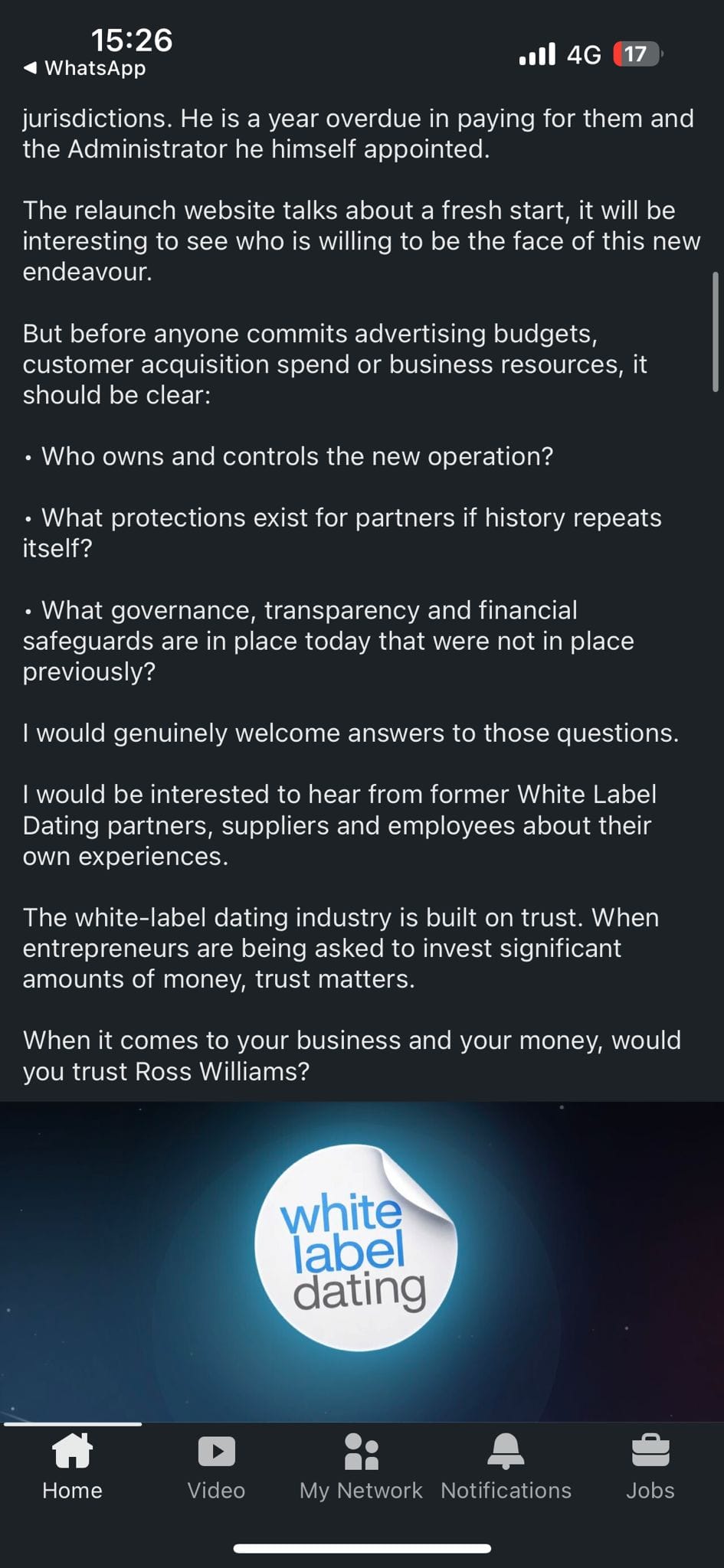
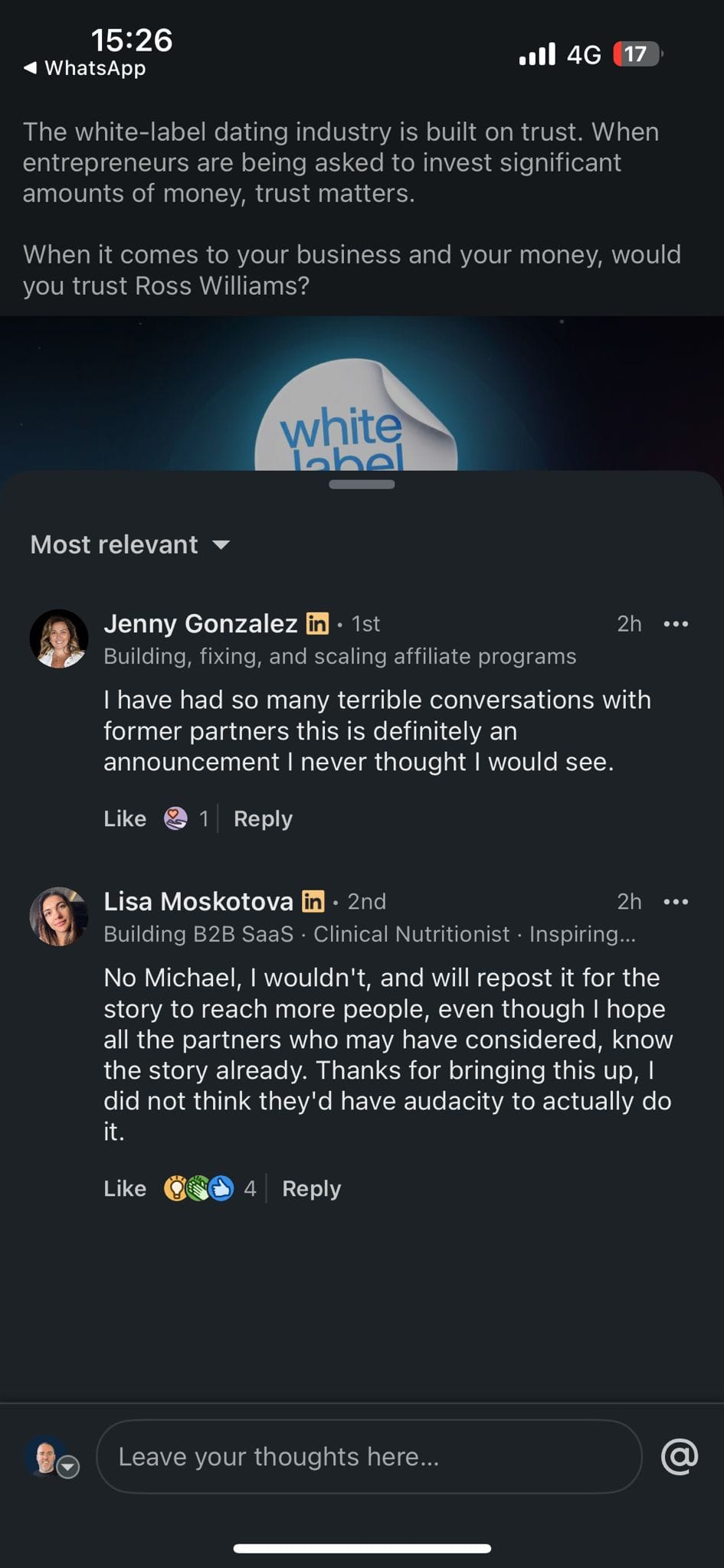
Four things before the story
Before I go on and explain what happened, let me clear up 4 key points quickly - then I'll share the full details of what happened:
- HubPeople doesn't own our members' database - however often Michael says he does.
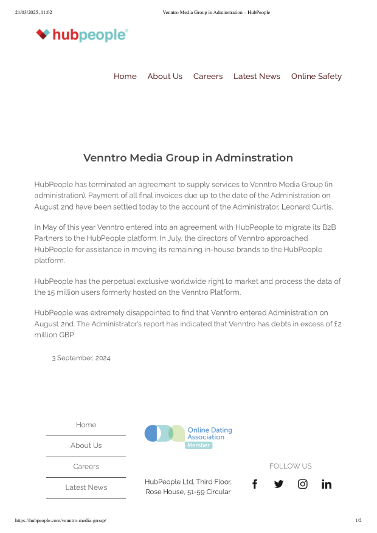
He's been saying it for two years now: to partners, at conferences, in legal letters, on LinkedIn. And on the day he terminated us, HubPeople posted a statement on its own website about its rights over "the data of the 15 million users formerly hosted on the Venntro Platform".
So let's start with the ownership claim, because every other part of his story stands on top of it.
Ask what that claim actually rests on, and you find one thing: a loan. In July 2024 HubPeople agreed to lend Ambervine £200,000, and sent half of it.
As security, we agreed that if the loan ever went into default, HubPeople could carry on using the database in the meantime. That is the entire foundation. There's nothing else underneath. And being allowed to use something is not the same as owning it - you can rent a house for years; it never becomes yours to sell.
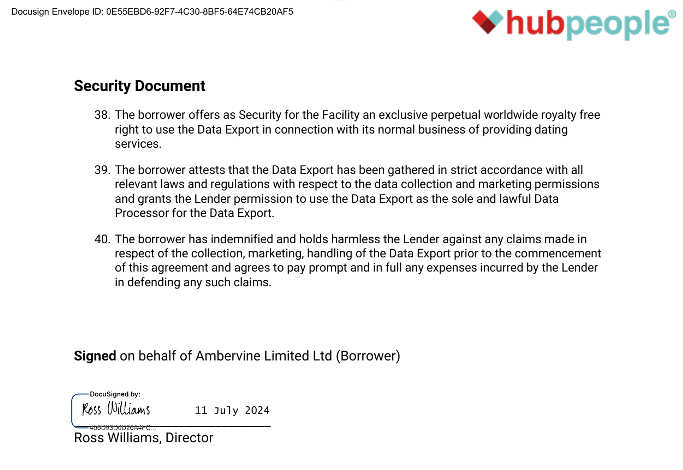
Now look at what his own paperwork actually says. The security document he relies on describes HubPeople, in black and white, as the "sole and lawful Data Processor" for the data.
A processor is a company that holds data on behalf of its owner - the warehouse, not the owner of the boxes.
The same loan paperwork promises that once the loan is repaid HubPeople "will return the Data Export", and forbids them from lending, selling or transferring it to anyone else. You don't promise to hand back - and agree never to sell - something that belongs to you. And on top of all that sits a simple legal test: to move ownership of a database from one company to another, the law requires a specific signed document, a deed of assignment. No such deed exists. It was never even drafted, because handing over ownership was never agreed.
Here's the tell. That statement HubPeople posted on its own website, the day it terminated us? It claimed
the perpetual exclusive worldwide right to market and process
the data. Read it carefully. Even at his boldest, on his own site, choosing his own words, Michael didn't claim to own it - because a right to "market and process" is the kind of right you have over somebody else's property. The ownership story came later, when it became useful.
And there's one more step, because it's the one that matters most if you read nothing else. Even a company that doesn't own data can have permission to use it — so ask where HubPeople's permission would come from. There were only ever two possible sources. The partnership agreement gave them permission to use the data to run our sites — and Michael terminated that agreement himself on 3 September 2024. The loan security gave them permission to use it if we were ever in default — and under the loan's own terms, echoed in Michael's own 28 August note, no default could even exist before July 2025.
So from the day he terminated, HubPeople had no ownership, no licence and no permission. Only possession. As the data controller, we formally instructed them to stop using our members' data and to return their copy.
They refused.
And here's the thing about data law: it has no exception for "but we're in a dispute." A processor uses people's data on the owner's instructions - that is the entire arrangement - and "he owes us money" is not a data right. If Michael believed he was owed £100,000, the law gave him courts for that - and in two years, he has never once used them. It did not give him fourteen and a half million people.
Remember the warehouse: the storage contract has ended, the owner has asked for the boxes back, and the warehouse has said no. It's been saying no ever since.
- HubPeople didn't lose money to Ambervine - it's the other way around
Michael's version is short: he transferred £100,000 and was never repaid. Here's the context he leaves out.
The £100,000 was half of a £200,000 loan facility he'd signed as part of our partnership deal (which was agreed right at the start) - at 0% interest, secured, and with repayment built into the machinery of the deal itself. Every month, a slice of the revenue our sites earned on his platform came off the top and went against the loan, before we got paid. Think of a record label advancing money to a band and taking it back out of the royalties. That was fair, we agreed to it, and it was working - his own meeting notes from 28 August list the loan deductions already taken.
Then he terminated the partnership - and switched off the repayment machine himself.
The loan was designed to be repaid out of revenue, and he ended the revenue.
Don't take my word for that: his own solicitors' termination letter says it in terms - "there is no longer a mechanism in place for repayment of the loan." Of course there wasn't. He'd just removed it. You can't lend someone money on terms that say "I'll take it back out of our joint takings", walk off with the takings, and then call yourself the victim of a bad debt. Yet Michael has been posting this on Linkedin as fact and misleading people.
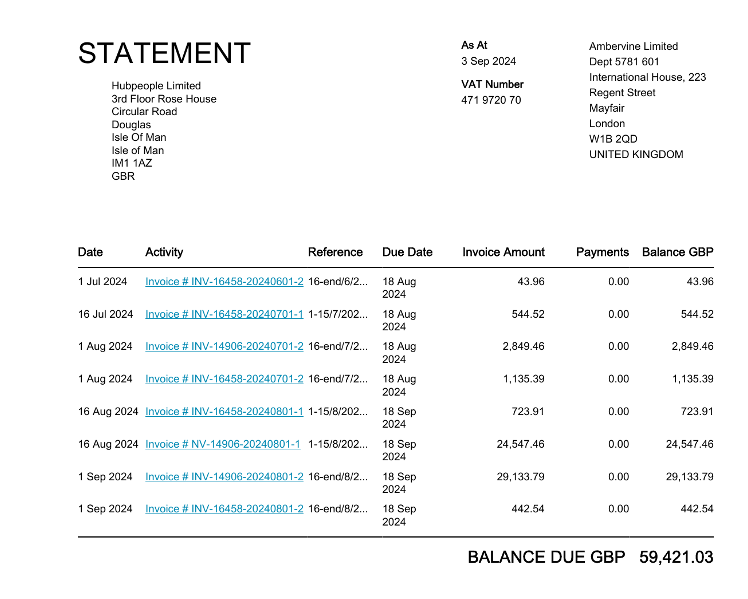
And look at what the takings were at that exact moment. On the day of the termination letter, the invoices generated by HubPeople's own billing platform showed £59,421.03 owed to us for July and August. He kept it, pointing at a forfeiture clause. So run the ledger honestly. He'd put in £100,000, part of it already recouped from our revenue. He was holding £59,421 of our money at the door. And he kept the asset itself - 14.5 million members, and everything they've earned for him since. Who lost money to whom? Which brings me to....
- HubPeople kept our 14.5 million members.
First, be clear about what "the database" actually is, because the word makes it sound like a spreadsheet. It's people. 14.5 million of them, who joined our dating sites over more than twenty years - their profiles, their photos, their private messages, their subscriptions. When our sites moved onto HubPeople's platform in July 2024, all of that came to live on his servers. Not as a gift - the way a shop's stock sits in a rented building. The building was his. The stock was ours.
Within days of terminating us, our members started getting emails telling them their account had "moved". They were rebranded onto HubPeople's own sites - Divergent Dating, Embrace, Shush, Senior Love Companions - complete with a 30%-off September promotion to get the subscriptions rolling again quickly.
Nobody asked these people. They'd joined our sites. They woke up as customers of brands they'd never heard of, run by a company they'd never knowingly dealt with - and from that day, the money they spent went to him.
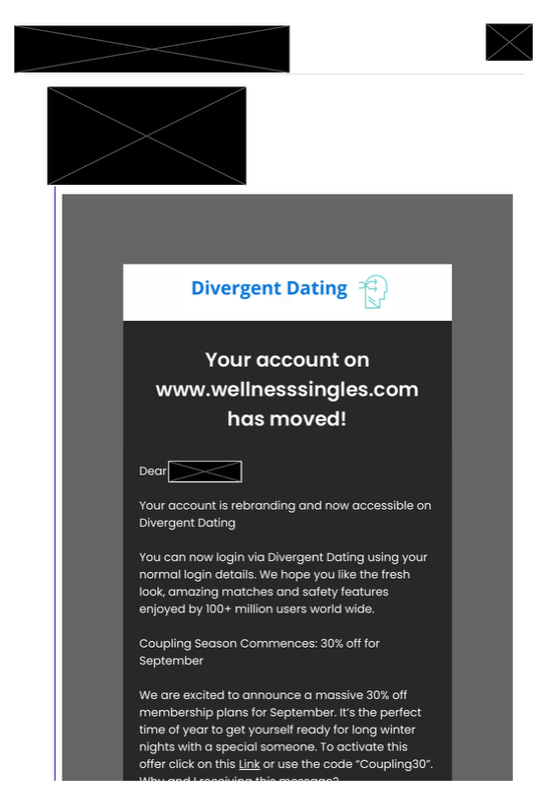
His own email to our members says the quiet part out loud: "your data has not been moved." Correct. That's the whole point. The data didn't move - it stayed exactly where it was, on his platform. The only thing that changed was who it earned for.
Twenty years of other people's sign-ups – twenty years of work by the people and partners of Venntro - became his customer base overnight, at a cost to him of precisely nothing.
And remember what his own loan paperwork promised: that on repayment, HubPeople "will return the Data Export". Ask yourself how returning it was ever supposed to work once he'd folded our members into his own brands?
- The money since. Here's what those members were worth - using HubPeople's own numbers, the figures his platform reported to us while we were partners. August 2024 was our first full month live. His reporting shows £84,887 gross revenue collected from our sites, with sign-ups in the second half of the month running 15% up on the first half. It was compounding and growing. Two months after losing everything at Venntro, the plan was working and I thought we'd be able to make good.
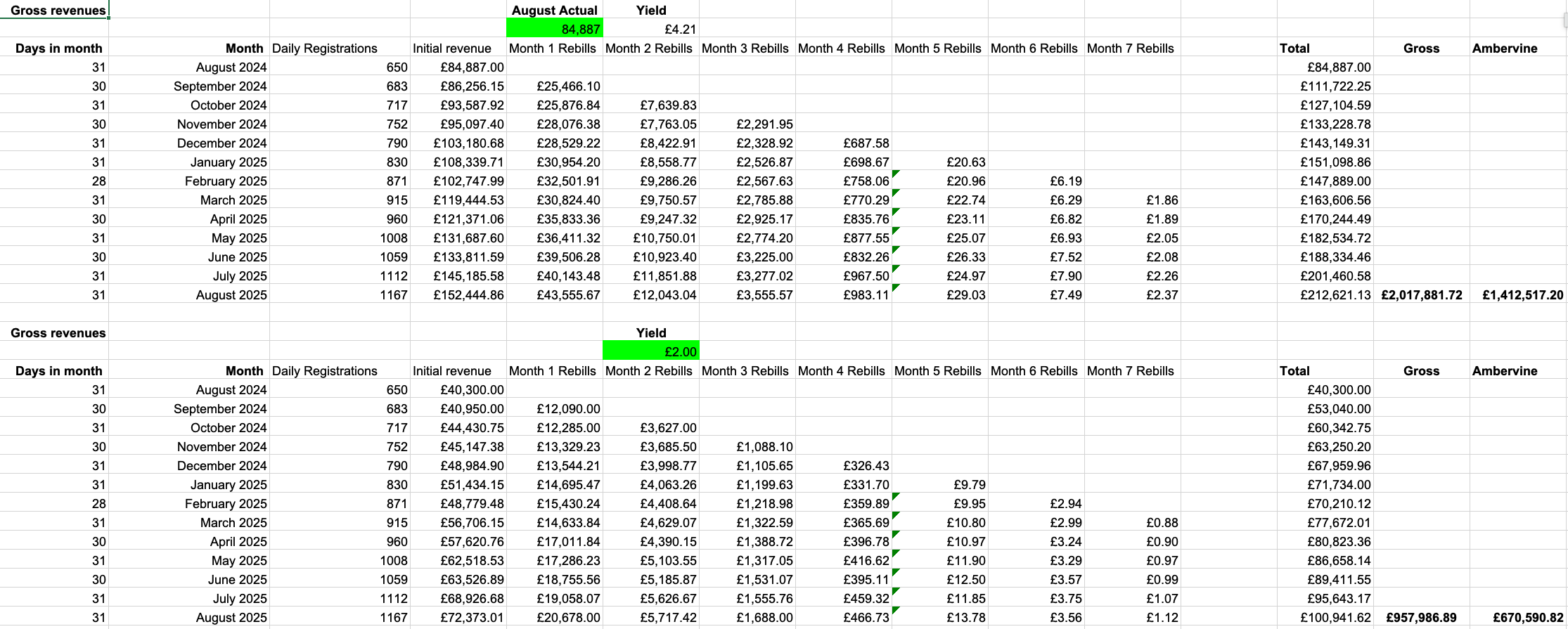
At the time, we projected those figures forward - starting from his platform's reported revenue and sign-ups, assuming steady, modest growth - and the members were on course to generate around £2 million in their first year alone. Our contracted share was 70% of that: roughly £1.4 million. Even our deliberately cautious version of the same forecast put our share at £670,000. And when it came to it, our lawyers put the amount we were owed at between £600,000 and £1.4m.
We received none of it. Not the forecast money. Not even the £59,421 already invoiced.
Now follow where that money went, because this is the part Michael never mentions. The revenue didn't stop existing when he terminated us. The members were still there - still subscribing, still renewing, on his platform, under his brands. The only thing the termination changed was the split: instead of 70% to us and 30% to him, it became 100% to him.
That has been true every single day for nearly two years. Our first month grossed £84,887 - we didn't see any of it - and each month since would have compounded and grown. For 23 months - all to Hubpeople, nobody else.
And it still understates it, because once our members were spread across the rest of his network, they were making his other partners' sites busier and more valuable too. So when he tells people he "lost" £100,000 - part-recouped before he switched the repayments off himself - weigh it against what he took in exchange: a twenty-year database on course to make £2 million a year.
If that's a loss, most businesses would take two.
Michael says he speaks for partners who lost money to Venntro. Good. Then here's a suggestion, made sincerely: the £84,887 his own system invoiced in the first month, and the seven-figure revenue stream he took over when he kept our members, would be an excellent place to start repaying them from.
Now the full story, in order, with dates. It's worth five minutes and gives the full story of what really happened.
The plan
When Venntro collapsed, I had a choice: walk away, or try to fix some of what I'd broken.
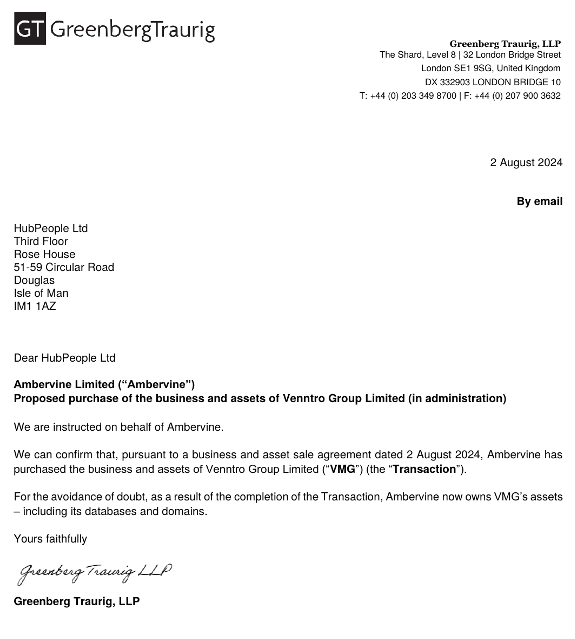
Ambervine - a separate company, and the one Michael's claims are actually about - bought Venntro's business and assets from the administrator on 2 August 2024, the day of the administration. Our lawyers, Greenberg Traurig, confirmed it to HubPeople in writing the same day: Ambervine owned the databases and the domains.
Worth knowing, and a matter our lawyers later put on the record: we believe HubPeople were linked to a rival bidder (a previous partner) for those same assets. We won the bid. Remember that as you read on.
The plan was simple and public: move our sites onto HubPeople's platform, strip out the crushing costs and debts that had helped sink Venntro, keep the team employed on the legacy and advertising revenue, and use what was left to personally repay the partners who'd lost out - within about six months, we would be able to do that.
This wasn't charity on Michael's part. It was a deal he liked. We'd signed a partnership agreement on 10–11 July: our members and sites on his platform, 70% of net revenue to us (of which 20% would repay that loan), plus a 10% referral commission. His words to me that July, when I asked for the terms we eventually agreed: "A lean profitable Ross is best for you, former partners and with a % me too. I suppose I could try to be an arse about it and extract more concessions but what you're asking for is fair and if it works a massive win win" – Michael knew this would be good for partners as I would be able to repay them.
And later that month on 20th July he messaged me to say "just don't want you thinking I've made my douche bag play and want to screw you."
Hold that thought.
The plan worked - that was the problem
Through July the database migrated - 14.5 million member profiles, at one point ingesting, in his words, five million users a day. Our sites relaunched on his platform. Through August we scaled: his own reporting shows registrations up 15% in the middle two weeks of the month, and £84,887 of gross revenue in August. The plan was working. The forecast we built from that first month - using the yield and volumes his platform reported - showed £2m gross projected in year one.
But while the numbers were coming good, the temperature on the other side of the partnership was changing.
I want to be fair about why I think it did.
Venntro's administration on 2 August had clearly rattled Michael - a company linked to the one he'd just lent money to had gone under, partners were understandably very angry and I understand how that looked from where he sat. If he'd picked up the phone and said, "the risk has changed, we need to talk about the terms," that would have been a reasonable conversation to ask for. It just isn't the conversation he chose. What happened over the next three weeks wasn't a renegotiation. It was an accumulation.
Our first revenue payments fell due on 18 August. They didn't arrive.
The money wasn't in dispute - his own platform had generated the invoices - it was simply held, and his own notes would shortly spell out the condition for releasing it: due "following agreement and solicitor clearance for AML issues". Following agreement. Sign the new terms, and then you'll be paid what you're already owed.
Meanwhile the second half of the loan - two further £50,000 instalments we'd planned around - never arrived at all; on 20 August we wrote formally asking where it was. And at Companies House, his side had found what they decided was a trump card: as part of buying Venntro's assets, Ambervine had given the administrator security over them until they were paid for - entirely normal in an administration purchase - and Michael's solicitors began describing that routine filing as a "default event" under our loan.
Now step back and look at the board as it stood in the last week of August. He held our 14.5 million members. He held our first month's takings. He'd sent only half the loan. And every new pound our sites earned passed through his platform before a penny of it reached us.
When a call went into the diary for the afternoon of the 28th August, I genuinely thought we were two partners working through teething problems. We weren't. As he'd shortly tell me himself, both routes out of that call had already been planned and paid for.
28 August 2024: the ultimatum
The call was in the diary for 3pm on Wednesday 28 August 2024. An hour, the four of us: me and David Adams, my co-director, on one side; Michael and Nicholas Orton, his CTO and a director of the company, on the other.
That pairing deserves a sentence of its own before we go on.
Michael tells the world he's the owner of HubPeople - it's how he frames his LinkedIn posts about me. But go looking for him in the legal paperwork of this story and he isn't there. The partnership agreement was signed by Nicholas Orton. The statutory demand you'll meet shortly was signed by Nicholas Orton too - who declares on it, in his own words, "I am the sole member of the creditor". The sole member: the company's shareholder.
The termination came from the solicitors.
So the man who was in the room for every negotiation, and behind every threat, and who publicly presents himself as the owner, somehow appears on none of the documents - while other men hold the titles.
I'll let you decide why a business might be arranged that way. Just hold onto the fact that it is.
We went into that call expecting a working session - the held payments, the AML clearance, the missing half of the loan.
Instead, they read out a new deal: drastically worse terms, take them or the partnership would be terminated. And they wanted our answer there and then, on the call.
David (my business partner) and I were stunned. Three weeks of the squeeze still hadn't prepared us for it. I'd walked in thinking we were partners fixing teething problems, and walked out having been handed an ultimatum with our own money as the leverage.
Two hours after we hung up, at 5:49pm, Michael's email arrived - opening with the remarkable claim that "we have accepted your verbal agreement to these terms", which will surprise anyone who reads what I actually said next.
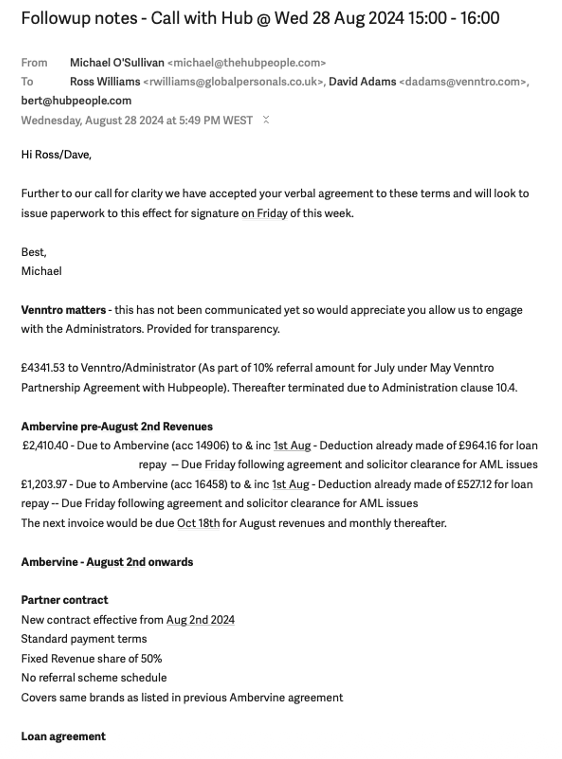
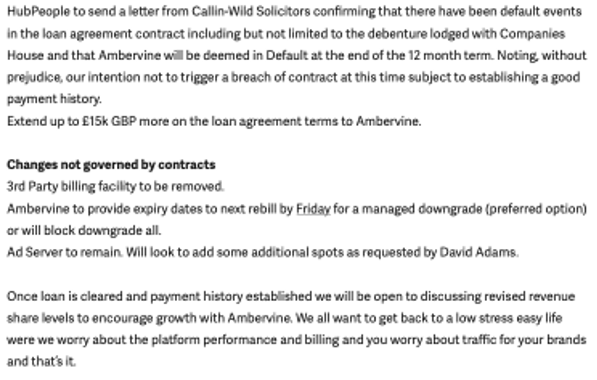
The new terms: our revenue share cut from 70% to a "fixed" 50%, backdated to the start of August. The 10% referral commission: gone. Payment terms pushed out so far that, as I wrote to him that same evening, we wouldn't see a penny until mid-October. And our third-party legacy billing - the one income stream HubPeople didn't control - to be shut down within a week.
With the loan repayments still coming off the top (his own meeting notes list the deductions being taken), the cash actually reaching us would have been roughly 30p of every pound our sites generated. Less than half what we'd signed six weeks earlier, on terms that would have starved us slowly instead of quickly.
But notice what else that email says, because it matters more than the numbers. It offered to extend us up to another £15,000 on the loan. It looked forward to "discussing revised revenue share levels to encourage growth with Ambervine" once the loan cleared.
And it recorded HubPeople's position that Ambervine would only "be deemed in Default at the end of the 12 month term" - their own note, accepting the loan couldn't be in default before July 2025. File that away for when the statutory demand turns up.
You do not offer to lend more money to a company you believe defrauded you. You do not talk about growing together with a partner you can lawfully sack for cause. The "cause" hadn't been invented yet.
I didn't reject the deal outright. I accepted almost all of it - the 50% share, the end of third-party billing - and asked for one thing: keep the legacy billing until 1 December so I could fund proper redundancy payments for staff on notice periods. Three months of runway to let people go decently.
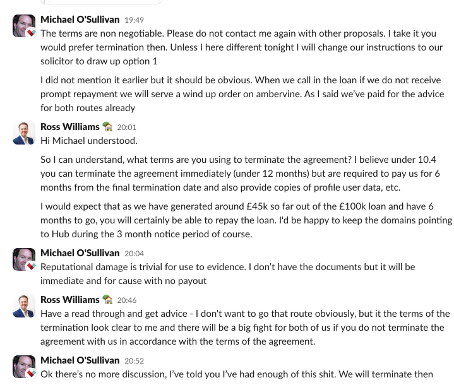
His reply, 7:49pm: "The terms are non negotiable. Please do not contact me again with other proposals. I take it you would prefer termination then."
And then, same message: "I did not mention it earlier but it should be obvious. When we call in the loan if we do not receive prompt repayment we will serve a wind up order on ambervine. As I said we've paid for the advice for both routes already."
You can see for yourself - read this Slack message:
He'd already paid for the advice. Both routes. Keep that one filed too.
I asked what grounds he could possibly terminate on. The contract had a proper exit: notice, and on a without-cause termination, six further months of payments on our members and copies of our user data handed back. Terminating "for cause" was the only door that cost him nothing - which rather explains what happened next. His answer, 8:04pm, is the single most revealing sentence in this whole story:
"Reputational damage is trivial for use to evidence. I don't have the documents but it will be immediate and for cause with no payout."
Read it slowly. I don't have the documents. But it will be immediate and for cause with no payout. The verdict came first; the evidence was going to be arranged afterwards.
Forty-eight minutes later:
"Ok there's no more discussion, I've told you I've had enough of this shit. We will terminate then."
That is what the ultimatum looked like. Stay, on terms designed to bleed us out - or be terminated "for cause" on evidence he admitted he didn't have.
There's a word for that kind of offer. I'll let you choose it.
3 September: the paperwork catches up
The formal termination letter arrived from his solicitors on 3 September, citing the goodwill-and-reputation clause.
Here's what that clause actually says: HubPeople may terminate immediately "if the Partner is convicted o[f] a criminal offence or act that in Hubpeople's reasonable opinion is likely to affect the goodwill and reputation of Hubpeople."
Our lawyers' position was simple: the clause turns on the word convicted, and nobody at Ambervine has ever been convicted of anything - or charged with anything. His lawyers preferred a looser reading.
You can judge for yourself; a court never got the chance to.
Meanwhile, the same termination letter helpfully confirms that the only thing said on 28 August was that if we didn't accept "the terms of a new contract" then HubPeople "may look to terminate". Their own solicitors, in writing: new terms, or termination.
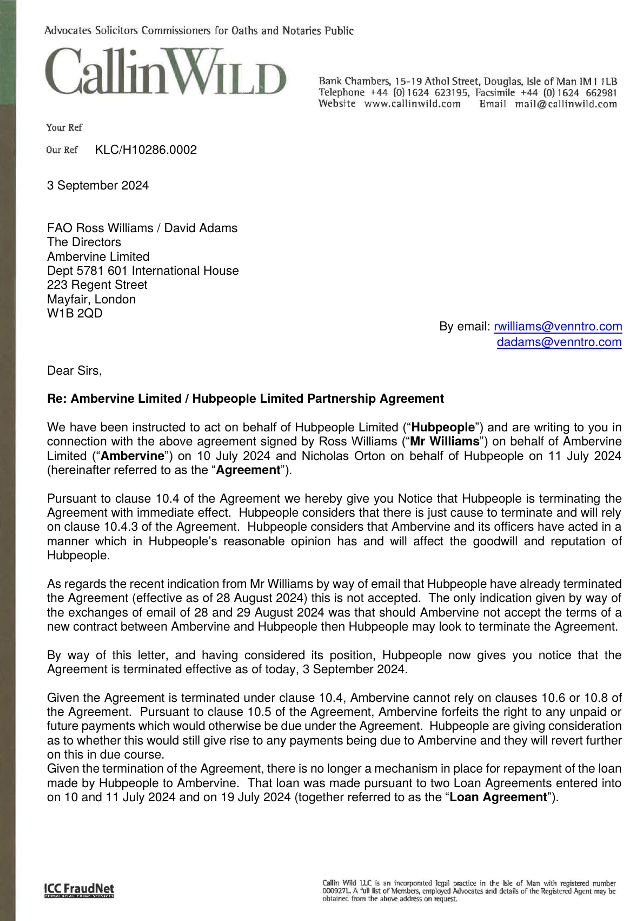
Two more things happened that day. HubPeople's own systems produced a statement showing £59,421.03 due to Ambervine for July and August. The termination letter announced we'd forfeited it. And HubPeople published a statement on its website claiming its "perpetual exclusive worldwide right to market and process the data of the 15 million users."
Oh - and that same termination letter offered us a new repayment plan to keep the loan agreement alive, £10,000 a month for ten months. On the same page as the for-cause termination of a supposedly untrustworthy fraudster. These are not the actions of a man who believes his own story.
Within days, our members were receiving the "your account has moved" emails. Our sites went dark; his filled up.
We began making redundancies the same week - four people first, and 25 in the end, every one of them a person I'd promised myself I could protect this time.
November: the demand, the processor, the advertisers
We tried to settle. On 15 October 2024 we offered - in writing - to let HubPeople keep using the data under a proper data processing agreement, to credit the entire £100,000 loan against what we were owed, to settle the difference at £79,421.03, and to share all future revenue 50/50.
Read that again: our opening offer repaid his loan in full, off the top.
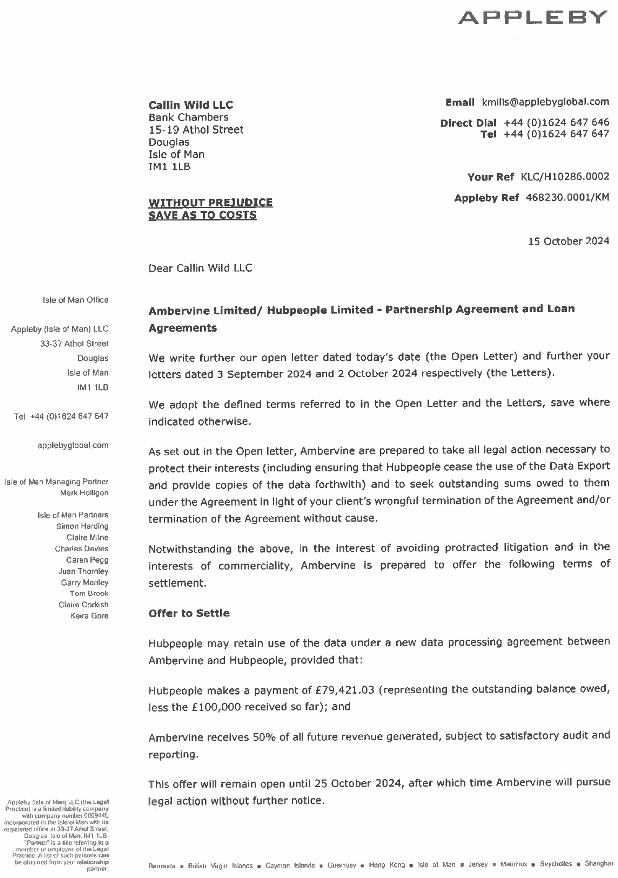
It expired ten days later, unaccepted.
On 5 December 2024 we offered to meet. His lawyers replied: "we do not consider that this would be productive at this point in time."
Instead, on 14 November 2024, HubPeople issued a statutory demand - the formal precursor to winding a company up - for the £100,000.
The demand was signed by Nicholas Orton and drafted so hastily it literally says Ambervine loaned the money to HubPeople. It claims the loan fell due on 2 October 2024.
Their own meeting note from 28 August had accepted no default was possible before July 2025. The loan agreement says, in terms, that the loan "cannot be considered to be in Default within the Term." A 0% loan, being repaid automatically out of revenue they collected and kept - and they charged interest on it in the demand anyway.
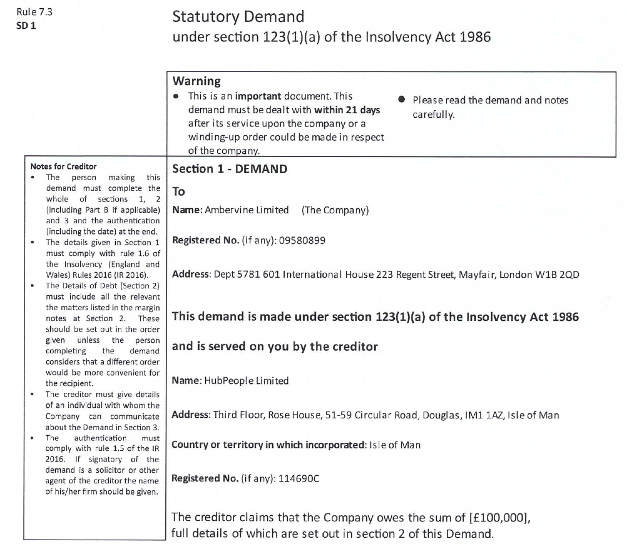
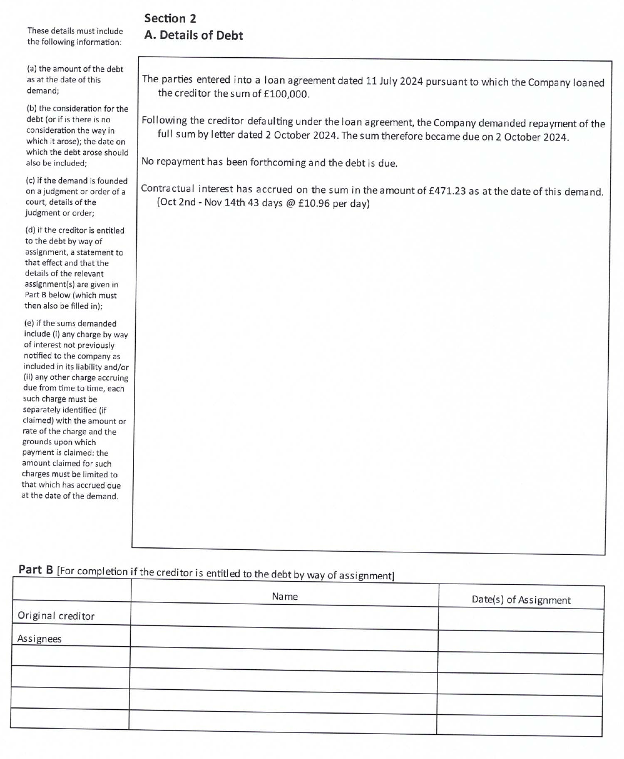
A statutory demand isn't a public document. It goes to the debtor only.
Yet within a week our acquiring bank - part of Shift4, the processor handling the legacy billing that was by then our only income - had a copy, and terminated every account with immediate effect, freezing our funds.
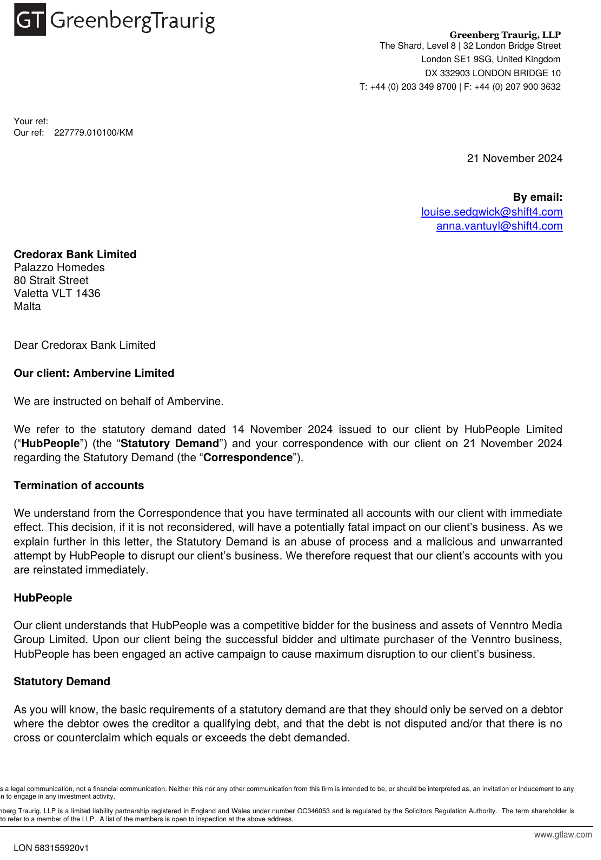
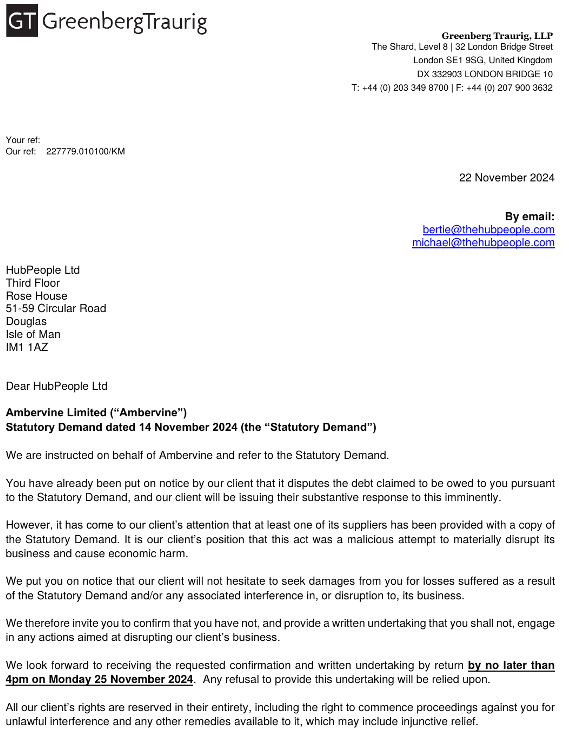
Our lawyers wrote to Shift4 that same day, 21 November, calling the demand "an abuse of process and a malicious and unwarranted attempt by HubPeople to disrupt our client's business", and to HubPeople the next day, noting "at least one of its suppliers has been provided with a copy of the Statutory Demand."
We know how Michael expected this to play out, because our lawyers also put on record that he'd been telling a partner that "Ambervine will lose their payment processing in the next few days."
He said it before it happened. It then happened.
That was the end.
The formal Shift4 termination landed on 29 November; by our estimate around £500,000 of ongoing legacy revenue we'd been counting on died with it, and the last of our staff went with it.
Twenty-five jobs - the very people the whole plan existed to protect.
He went for the advertising too. On 3 December his Executive Assistant emailed our advertising platform demanding "the immediate suspension of Ambervine's advertising account", claiming our own members' data infringed "our exclusive intellectual property rights". Our data. His IP. In writing, from his office.
And in January 2025 he followed through on the threat he'd "paid for the advice" on: a winding-up petition against Ambervine, presented to the High Court on 31 January 2025.
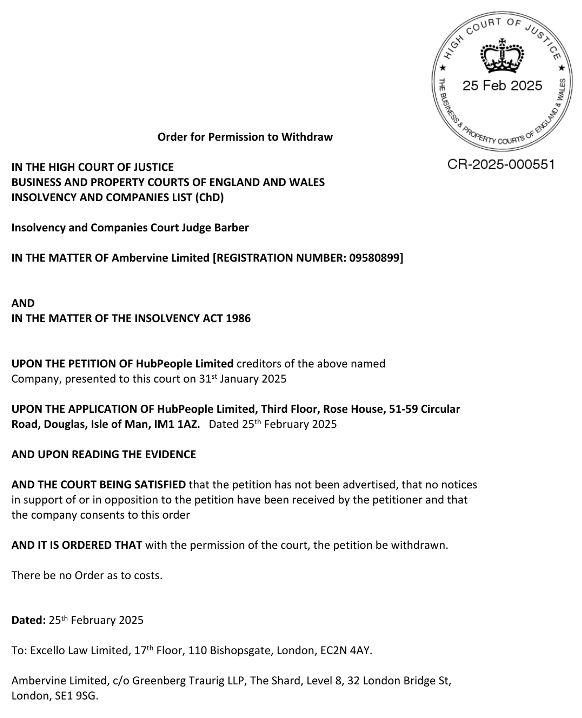
When our lawyers challenged it as an abuse of process and demanded it never be advertised, it was withdrawn - by consent, on 25 February, never advertised, with no order as to costs. He took it to the courthouse door and dropped it the moment it was tested.
You don't usually abandon a winning hand.
And in the seventeen months since, he has never tried again. Not a claim, not an arbitration, not a fresh demand - nothing but LinkedIn posts.
Think about that. If someone genuinely owes you £100,000, a judge is the cheapest thing in the world to ask - you issue a claim, the judge reads the loan agreement, you win. He has never asked. The one time his demand got near a courtroom, he withdrew it before anyone could look.
And remember, he'd already been offered the £100,000 back in writing, in October 2024, credited in full - he let that lapse too.
A man who keeps telling the internet he's owed money, while carefully never asking a judge to agree with him, is telling you something. Just not what he thinks he's telling you.
Starving the fight

There's an idea that runs right through Sun Tzu's Art of War, and it's stayed with me these two years: the cleverest general never fights the battle. He makes the battle impossible. Poison the wells. Burn the crops. Cut the supply lines.
An army that can't eat surrenders before a sword is drawn, and the general who starved it gets to say he never attacked anyone.
I can't tell you what was in Michael's head. I can only show you the sequence, and you've just read it.
- Our revenue share: witheld.
- Our members: taken into his brands.
- Our payment processing: dead within days of a supposedly private legal document reaching our bank, after Michael told others it would happen.
- Our advertisers: warned off by his office.
And behind it all, in writing, before any of it: "we've paid for the advice for both routes already."
Every single move took away a source of cash. And a company with no cash cannot go to court. That's the whole trick.
It doesn't matter how strong your case is - and ours was strong: wrongful termination, £600,000 to £1.4m owed, a set-off that swallowed his loan claim whole - because arbitration in the Isle of Man costs serious money, and we had none. I'd lost everything I had in Venntro.
My wife then put her own savings into Ambervine to keep it breathing, and lost those too. That's the part I find hardest to write.
His tactic worked. I want to be honest about that, because pretending otherwise would be its own kind of lie.
We were right, and we were beaten, and those two things turned out to be unrelated.
He didn't out-argue us. He made sure the argument could never afford to happen.
The data, plainly
One more thing needs saying carefully, because it's not really about me and Michael at all. It's about 14.5 million real people.
HubPeople held our members' data as our data processor - their own security document's word, not mine. When the relationship ended, we instructed them, as the data controller, to stop processing our members' data and hand back their copy.
That instruction isn't a negotiating position; under data protection law a processor processes on the controller's instructions, full stop.
You cannot keep someone's data because you're having a contract dispute with them, any more than the warehouse gets to keep your boxes because you're arguing about the storage bill.
And you certainly don't get to pour those people into your own brands and bill them under new names.
They refused. So in June 2025 we reported it to the Information Commissioners in both the UK and the Isle of Man: a processor continuing to use 14.5 million people's personal data - much of it, given the nature of dating sites, deeply private - against the controller's express instruction.
The ICO's response was that they regarded it as a contractual dispute between two companies, and there it died. I understand why a stretched regulator reaches for that shelf. It doesn't make it the right shelf.
The honest bit
No court or arbitrator has ruled on any of this. I want that stated plainly, because Michael won't be the only one who notices.
We never got a ruling for exactly the reason above: the side that keeps the money decides whether the other side can afford a referee.
What I can tell you is that every document quoted here exists, that his side withdrew the one piece of litigation they actually started, and that every attempt we made to get into a room - a settlement offer in October 2024, a meeting offered in December 2024 and declined, a further push for without-prejudice talks in June 2025 - went nowhere.
Where the sites are now
By mid-2025 we accepted reality and moved on.
We honoured our obligations to Venntro's administrator - Leonard Curtis were kept informed of every step throughout, including when HubPeople's actions forced the payment schedule to be renegotiated - and we delivered on our commitments under the administration, despite Hubpeople's best efforts.
And when Michael notes darkly on LinkedIn that I'm the one who appointed the administrator - well, yes. That's how administration works. Directors appoint a licensed insolvency practitioner precisely so that someone independent takes over. It's not a loyalty programme.
Earlier this year, Bill Alena of High Intent Media approached me about the sites.
I've known Bill for many years and I respect him. When he explained his vision for what the dating industry could become, I recognised something I hadn't felt about this industry in a long time: he's right.
If online dating has a future worth having, it looks like the one he's building.
So let me say this as clearly as I can, because Michael is already insinuating otherwise. I have no wish to be in the online dating industry. None.
I'm happier in the work I do now in my day job and also building the Fortitude Foundation - helping founders survive the kind of collapse I barely survived - than I ever was running a dating company.
I was a prisoner in my own business at Venntro for the last 5 years of it's existence, unable to leave and imprisoned in a business of my own making. I’ve since met many other entrepreneurs who felt the same – trapped running a business they don’t enjoy anymore out of a misjudged sense of loyalty to staff, partners and a future of what might have been.
I wanted our sites, and above all our members, to have a good home with someone who'd treat them properly.
In High Intent, I believe they do. No money changed hands, and I am not a shareholder of High Intent Media Group.
The questions I'd want answered, if I were a partner
Michael positions himself as the man standing up for the partners Venntro let down.
Some of those partners are people I owe apologies to – partners I worked with for up to two decades and let them down when the company failed.
So this section isn't for Michael or others; it's for these partners. Before you continue to take his version on trust, ask yourselves:
- Did you know that six days before terminating us "for cause", he offered to keep us on as a partner - and to extend us up to a further £15,000 of credit? Who offers more credit to a man he's about to denounce as untrustworthy?
- Did you know his own billing system invoiced £59,421.03 owed to us at termination, and that he kept it? Did any of it reach you? Did he pay you the money he generated from our members?
- Did you know that the members he says cost him money have been earning for HubPeople every single day since September 2024 - a book of business his own August numbers valued at £2m a year - while he told a mutual contact about the "huge performance uplift" the data had given his platform, at the same time as pleading poverty in legal letters?
And when he says he's the one left out of pocket, it's fair to ask how that squares that with the private island his company owns off Arran - the Isle of Pladda (it has its own website) - and the motor yacht named after it, the Pladda Porpoise.
I'm not telling you what his money bought. I'm telling you what ours never did: it never came back, to us or, as far as I can tell, to partners or staff affected by these actions.
The End
If you’re still here - thank you for reading this far.
I failed with Venntro, and I'll answer for that for the rest of my life - to the people I let down, first and always.
What I won't do any longer is stay quiet while the man holding our members and our money asks the internet whether I'm the one who can't be trusted and continues to post about me and others as Judge and Juror. I have written this account because of his continued public statements about me nearly 2 years later. The mediation offers I've made over the last two years still stand, though I won't hold my breath.
The receipts exist. The contracts, the Slack messages, his emails, the statements, the sealed court order. If you genuinely want to see them, ask me.
I wish this had worked out and we'd be able to recover some good for partners and staff from the bad situation I got us into at Venntro. But it didn't work out and I can't change the past.
Now I'm going back to work that matters to me and to my family. To Life.
And I suggest you do too x


